
Abstract
Carcass cord bulge failure in truck and bus radial (TBR) tires predominantly occurs in the shoulder area and is a critical issue affecting tire performance and safety. This study examined 13 market-returned failed tires of various patterns and sizes through a multi-step analytical methodology: visual inspection, X-ray detection, shearography, microscopic analysis, FTIR spectroscopy, and adhesion testing to characterize the failure mechanism.
Visual inspection identified external causes such as punctures, overload, and bead damage; X-ray ruled out structural defects like uneven cord spacing or belt misalignment, indicating that failure originated from intrinsic interface interactions. Shearography located early latent delamination, which was then examined microscopically. Microscopy revealed that the initial failure mode was carcass ply-rubber interfacial debonding, with cracks propagating along cord surfaces and spreading to adjacent cords. FTIR combined with 90° peel testing distinguished rubber bulk degradation from adhesive layer aging. FTIR confirmed stable chemical state with no carbonyl formation or olefin/vinyl group loss. However, adhesion testing showed reduced bond strength correlated with bulge initiation: samples without bulge initiation had a minimum bond strength of 13 kgf/inch, while samples with visible initiation had a maximum bond strength of only 13 kgf/inch. This proves that adhesive layer aging is the root cause of failure. This study reveals the TBR cord bulge failure mechanism and establishes a complete failure root-cause analysis methodology.
Keywords: carcass cord bulge; TBR tire; X-ray; shearography; FTIR; 90° peel test; adhesion failure
1. Introduction
Like all mechanical components, tires have a defined service life, measured in miles — the distance a tire can travel under specific load and operating conditions. When manufacturers receive feedback that actual tire life falls short of design expectations, the root cause must be identified. Such failures not only harm profitability and sales but also trigger customer tire replacement claims.
Over the past decade, the TBR tire industry completed its radial technology transition, with continuous focus on improving mileage. Early research centered on tread friction; later work shifted to heat dissipation and rolling resistance reduction. Since 2020, TPMS and AI have been increasingly used to improve tire performance and optimize manufacturing.
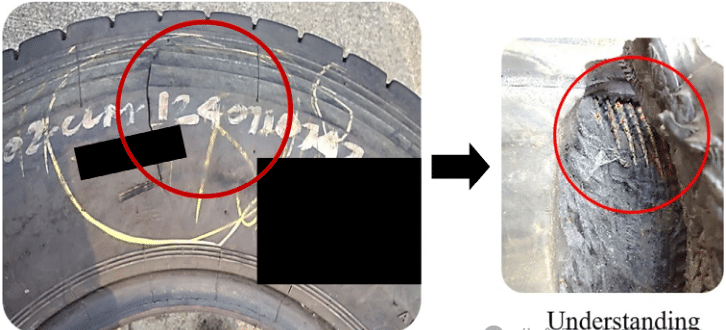
Despite technological advances, various tire failure modes remain persistent industry challenges. Common modes include tread delamination, belt delamination, and sidewall delamination. Among these, carcass cord bulge failure is particularly severe, causing tire carcass deformation. In this mode, the carcass ply displaces inward toward the inner liner; air penetrates the interface, forming a bulge on the outer surface that eventually bursts. This is also called ply separation — the ply delaminates from the sidewall rubber. Such blowouts cause loss of vehicle stability and increase accident risk (Figure 1).
Extensive literature covers various tire failure mechanisms: belt delamination has been thoroughly studied (belt angle, rubber thickness, belt width); crack propagation direction has been investigated using optimization methods. Tread delamination and bead failures are also well documented. Giapponi (2008) comprehensively reviewed tire failure causes. However, published research specifically on carcass cord bulge failure remains very limited — only Jeong et al. (2019) used FEA to predict and optimize structural durability. Significant research gaps remain.
Tire failure causes are diverse — overload (e.g., running at 200% rated load), puncture, manufacturing defects. This study distinguishes whether cord bulge originates from cohesive failure of the rubber bulk or adhesive failure at the steel cord-rubber interface. The core question: what causes adhesion degradation? Is it aging thickening the copper sulfide (CuₓS) adhesive layer making it brittle, or thermo-oxidative degradation of the rubber bulk from prolonged heat and air exposure in the shoulder region?
To answer this, manufacturing defects and misuse were excluded from analysis; crack nucleation and propagation paths were traced to determine failure location and mechanism. This study proposes a systematic verification methodology, analyzing 13 market-returned failed TBR tires of different models, operating conditions, sizes, and tread patterns: 8 from Salem market, 5 from Bikaner market (Table 1).
Table 1: Tire models and operating conditions (13 samples of TBR tires including tubed and tubeless, sizes 9R20, 10R20, 295/80R22.5; wear ranging from 19% to 69%).
This paper is structured as: Section 2 provides theoretical background on composite failure, tire tension distribution, rubber aging, and rubber-steel adhesion; Section 3 describes the experimental methodology; Section 4 presents results; Section 5 gives conclusions.
2. Theoretical Background
A tire is a complex composite of 30+ components. A typical TBR tire includes tread, belt plies, carcass ply, sidewall, inner liner, apex, and bead wire. TBR tires generally contain 5 steel cord plies, 4 belt plies, and 1 carcass ply. Steel cords are coated with thin rubber called the skim compound. This is a fiber-reinforced rubber (FRR) composite: fiber phase = steel cords, matrix = rubber. Each ply is a lamina; stacked laminae form a laminate.
2.1 Load Transfer and Damage Mechanisms
In composites, most load is borne by fibers; the matrix holds fibers in place. Under axial tension, fibers transfer load to the matrix via interfacial shear stress. Initially fibers carry maximum tensile stress; shear stress is lowest at the fiber surface and increases toward the matrix, reaching a maximum before dropping to zero (Figure 2a).
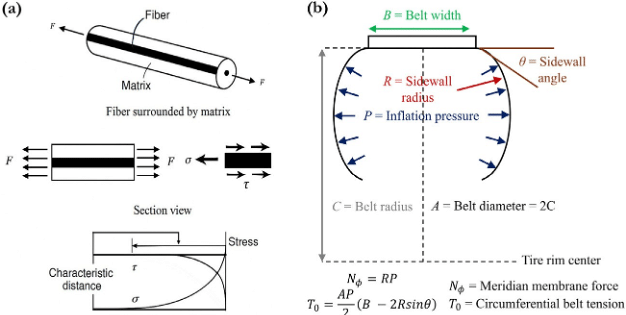
Inside the tire, inflation pressure tensions the belts and carcass plies. Carcass ply tension relates to curvature radius; belt tension depends on outer diameter, width, and belt angle (Figure 2b). Complete laminate failure requires multiple local damages first. Damage mechanisms in fiber composites fall into three categories:
- Micro-mechanical damage: within a single lamina;
- Macro-mechanical damage: at the laminate level;
- Micro-macro coupled damage: cracks initiate within a lamina then propagate into interlaminar delamination.
2.2 Rubber Degradation
Under environmental factors and mechanical loading, tire rubber degrades over time, compromising structural integrity. Degradation has two modes: thermo-oxidative aging (oxygen + heat cause chain scission, reduced elasticity, increased hardness, cracking) and mechanical aging (continuous deformation during rolling causes progressive damage, fatigue crack initiation at stress concentrations).
Crack initiation in cord bulge occurs near the carcass ply where skim rubber is extremely thin, preventing direct physical comparison between failed and new tires. FTIR was used to assess aging by identifying chemical changes through characteristic absorption peaks. Thermo-oxidative aging produces abundant carbonyls while reducing olefinic/vinyl groups; mechanical aging produces both alcohol and carbonyl groups.
2.3 Rubber-Steel Adhesion and Degradation
Tire steel cords are brass-plated; adhesion relies on the copper-zinc alloy layer. During vulcanization, rubber reacts with brass to form a copper sulfide (CuₓS) interlayer that mechanically interlocks with the crosslinked rubber network. Compounding ingredients — accelerators, sulfur, cobalt salts — are critical for promoting metal-sulfur interaction.
Loss of steel-rubber adhesion is mainly caused by thermal aging, oxygen exposure, and moisture. Thermal aging thickens the CuₓS layer (brittle, crack-prone); oxygen oxidizes CuₓS to CuSO₄ (poor cohesive strength); moisture + oxygen cause cathodic corrosion producing Zn²⁺ and Zn(OH)₂. This study uses the 90° peel test to evaluate carcass ply-rubber bond strength.
3. Experimental Methods
3.1 Visual Inspection
Comprehensive visual inspection assessed whether puncture, impact, overload, or overheating triggered cord bulge. All tires were cleaned; serial-number side (SS) and non-serial side (NSS) were marked. Failure locations were recorded, checking for punctures, inner liner splice failures, bead damage, and flat spots — defects that allow moisture/air ingress.
3.2 X-Ray Inspection
After visual inspection, X-ray identified defects in belt, sidewall, and bead areas, focusing on manufacturing-related structural damage to steel components. Locating pins were inserted opposite the marked failure area. Focus was on upper sidewall region and carcass cord spacing — excessive or uneven spacing allows rubber deformation under inflation pressure, thinning and eventual tearing. Irregular spacing near failure was flagged as a potential building drum (TBM) defect.
3.3 Shearography
Shearography is a laser technique detecting internal voids and delamination under varying pressure/temperature. After X-ray, shearography identified early latent delamination invisible to the naked eye. Three scans covered 8 sectors (45° each) around the 360° circumference: lower sidewall, crown, and upper sidewall.
3.4 Microscopic Analysis
After shearography marked latent delamination areas, thin sections were cut using a diamond wire tire cutter. A DinoLite Premier AM7013MZT4 digital microscope examined specimens; an awl was used to open crack initiation zones. The primary goal was to locate the exact crack origin, then study propagation direction across multiple sections.
3.5 FTIR Spectroscopy
ATR-mode FTIR tested whether crack initiation was caused by rubber degradation. Skim rubber samples were taken from cord surfaces at both crack-initiation and sound areas. Two new tires served as controls: one fresh, one artificially aged in a climate chamber (100°C, 50% N₂ + 50% O₂, 30 days). Comparisons were made between: (1) new, worn-market-returned, and lab-aged tires; (2) cracked vs. uncracked areas on the same tire.
3.6 Adhesion Testing
A universal testing machine (UTM) performed 90° peel tests to confirm whether crack initiation was caused by bond strength loss. Two groups were prepared: Group A — market-returned bulged tires without visible shoulder crack initiation; Group B — same bulged tires with visible crack initiation. Both groups were peel-tested and compared.
4. Results and Discussion
4.1 Visual, X-Ray, and Shearography Results
Visual inspection found that cord bulge failure predominantly occurred in the upper sidewall, with no preference for SS or NSS — failure could occur at any circumferential position (Figure 4a). All failed tires showed cord shadowing inside and exposed cords externally (Figure 4b). Of 13 tires, 3 had punctures, but only 2 were adjacent to the failure. Flat spots from hard braking were observed near failures; one tire had impact damage directly at the failure (Figure 4c,d).
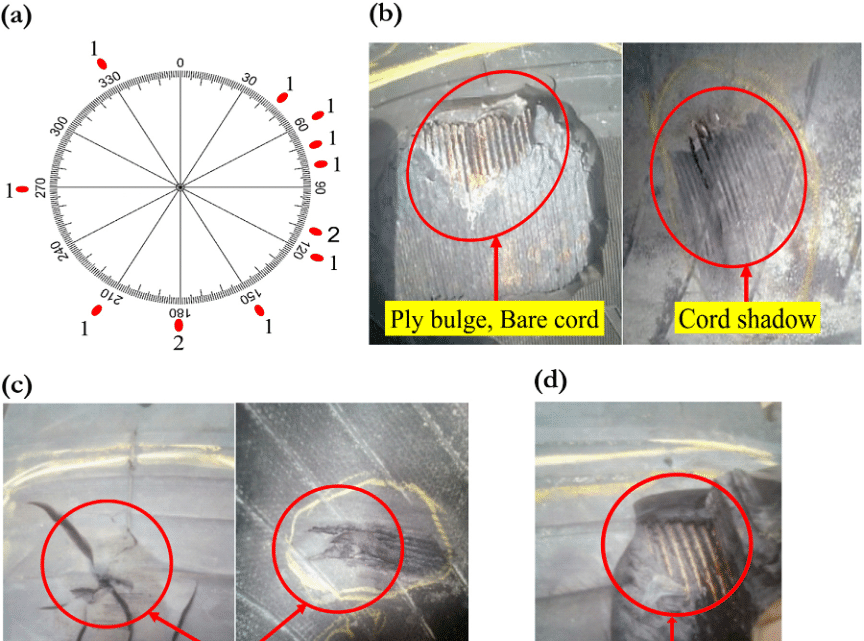
Excluding tire #3, average wear was 48.53%. Salem market averaged 56.97% wear; Bikaner averaged 36.73% — lower in Bikaner because overloading causes early bulge failure before significant wear. External factors (impact, puncture, flat spot, overload) accelerate local stress accumulation and promote bulge failure.
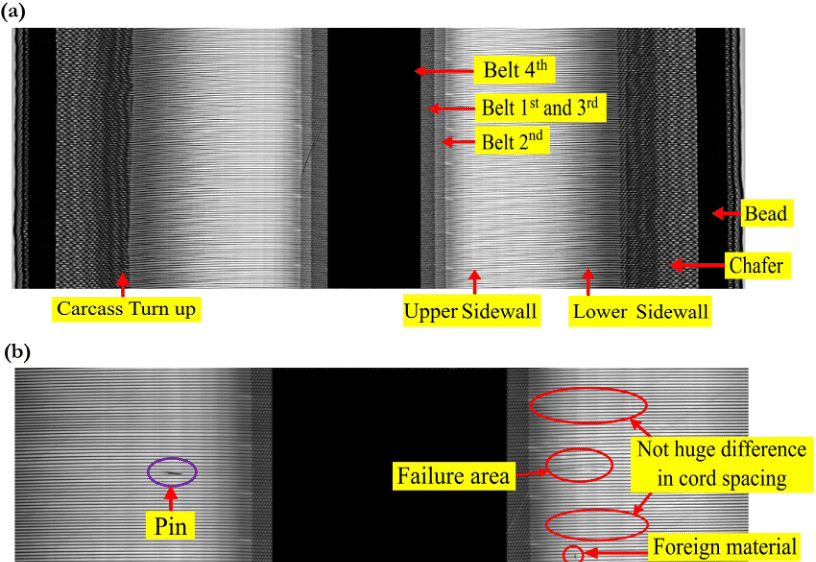
X-ray showed no significant manufacturing defects — cord spacing near failure was within acceptable range (Figure 5), confirming that bulge failure is not manufacturing-related.
Shearography showed varying interference fringe patterns indicating delamination severity. Six tires (#1, 2, 7, 10, 11, 12) showed early latent ply delamination in the turn-up area, belt edges, and shoulder ply — these isolated locations represent true delamination origins and were sampled for microscopy.
4.2 Sectioning and Microscopy
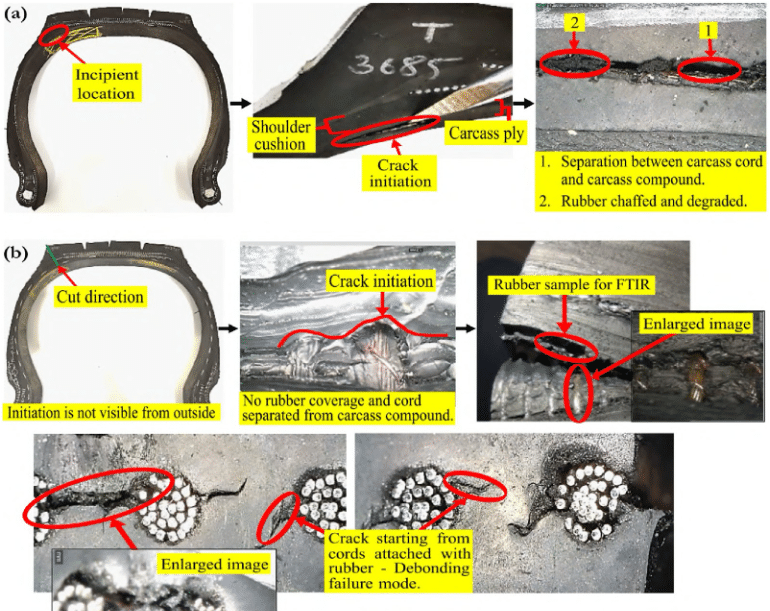
All sections were checked for geometric deviations (belt offset, turn-up offset, gauge thickness) — all within tolerance. Microscopy of the 6 latent-delamination samples confirmed that cracks initiated within the carcass ply, just below the shoulder wedge compound. Clear separation between cords and skim rubber was observed; at initiation, rolling/wear had removed rubber from cord surfaces but the brass plating remained intact. Cracks initiated at the cord-rubber interface, not within the rubber bulk — interfacial debonding along individual cords, then spreading to adjacent cords.
4.3 Crack Initiation and Propagation Mechanism
From a composites perspective, each ply is an independent lamina — failure originates within a single carcass ply lamina, not between plies. It begins as transverse fiber-matrix debonding along steel cords, driven by stress concentration and interface degradation. Once debonding reaches sufficient length, the crack enters the rubber matrix and spreads to adjacent cords — a micro-macro coupled damage mode. Cracks grow across 2–4 cords, causing macroscopic delamination that separates the carcass ply from surrounding structure. Delamination leads to ply tearing, inner liner breach, gas leakage, sidewall bulge, and catastrophic blowout.
Some cord areas showed reddish-brown discoloration — oxidation of the steel cords.
4.4 FTIR Results
FTIR focused on carbonyl, olefinic, and vinyl regions. Oxidative degradation increases carbonyl/hydroxyl/ether signals (1800–1700 cm⁻¹ carbonyl; 3400–3300 cm⁻¹ hydroxyl; 1200–1000 cm⁻¹ ether) and decreases olefinic C=C (1660–1640 cm⁻¹) and vinyl signals (910–890 cm⁻¹).
Crucially, no carbonyl formation was detected in market-returned tires — oxidation was not the dominant reaction, likely because antioxidants scavenged carbonyl products into secondary amines/imines/nitroso byproducts. Vinyl and olefinic groups showed no significant decrease vs. new tires. In contrast, climate-chamber aged samples showed severe degradation (vinyl nearly vanished, olefins dropped). Conclusion: rubber bulk degradation is minimal and not the failure cause.
4.5 Adhesion Test Results
New tire bond strengths: crown area 23 kgf/inch; sidewall 100 kgf/inch. Market-returned tires tested lower than new-tire standards, so relative comparison between Group A (no crack initiation) and Group B (crack initiation) was used.
Table 2: Peel adhesion test results — Group A (no initiation) consistently showed higher bond strength than Group B (with initiation) across both ply-to-belt and ply-to-sidewall interfaces.
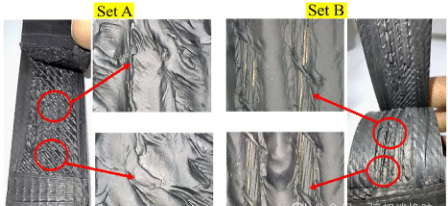
Group A (no crack initiation) showed cohesive failure with rubber coverage >3; Group B showed mixed adhesive-cohesive failure. Key finding: Group A minimum bond strength ≈ 13 kgf/inch; Group B maximum bond strength ≈ 13 kgf/inch — a clear threshold separating sound from initiated tires.
5. Conclusions
This study systematically investigated TBR carcass cord bulge failure, filling a literature gap. The failure sequence: interfacial weak layer breakdown → cord-rubber debonding along shoulder cords → stress concentration under rolling loads → crack propagation to adjacent cords → ply separation → inner liner breach → gas leakage → sidewall bulge → catastrophic blowout.
Key findings:
- External factors: Impact, puncture, flat spots, and overload accelerate local stress buildup and promote bulge failure.
- Manufacturing factors: X-ray and sectioning confirm no abnormalities in cord spacing, gauge, or belt alignment — failure is not manufacturing-related.
- Rubber bulk aging: FTIR confirms the carcass rubber remains chemically sound; antioxidants effectively suppress degradation — rubber bulk aging is not the cause.
- Adhesive layer degradation: The root cause is aging of the cord-rubber adhesive interlayer. Microscopy and 90° peel testing confirm reduced bond strength in tires with crack initiation.
Two directions for delaying TBR cord bulge failure: (1) improve cord-rubber adhesion through new skim compound formulations and optimized brass plating in coordination with cord manufacturers; (2) structural optimization — adjust carcass ply curvature for more uniform tension distribution, and modify belt structure for greater circumferential stiffness. These measures will improve tire performance, extend mileage, and reduce commercial tire blowout risk.