
Rubber Calendering: Common Problems and Solutions
Rubber Calendering: Common Problems and Solutions
This Q&A guide covers the essential questions about rubber calendering — process principles, machine types, deflection compensation, calendering effect, pre-calendering preparation, sheet pressing, plying, profiling, fabric frictioning, and common quality defects with their root causes.
Keywords: rubber calendering; calender; calendering effect; frictioning; topping; fabric coating; rubber processing
1. What Is Calendering and How Does It Work?
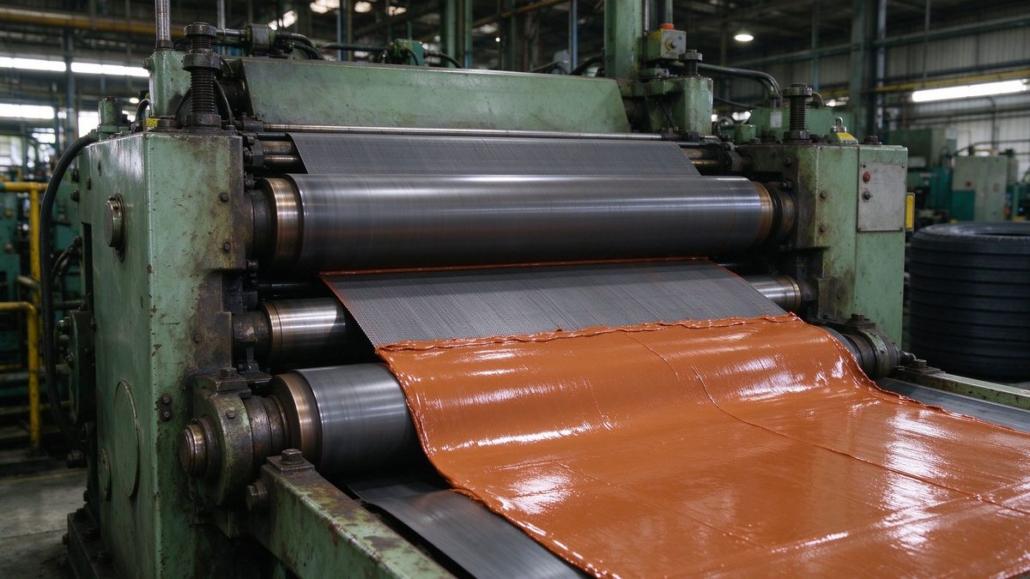
Calendering is the process of forming mixed rubber compound into sheets of specified thickness and width, or coating a thin rubber layer onto textile fabric. It covers rubber sheeting, profiling, topping, frictioning, plying, cold refining, and straining operations.
Principle: Rubber is fed between two rotating work rolls, drawn into the roll gap, and squeezed into a sheet of controlled thickness and width. During calendering, the compound undergoes both viscous flow and elastic deformation — so all calendering phenomena are closely tied to rubber flow behavior and viscoelasticity.
2. Calender Types and Model Designation
Calenders are classified by:
- Number of rolls: two-roll, three-roll, four-roll.
- Purpose: sheeting calenders (uniform roll speed, 3–4 rolls); frictioning calenders (roll speed ratios, usually 3-roll); universal calenders (adjustable speed ratios via auxiliary gears); profiling calenders (one engraved roll for patterned sheets); steel cord calenders (four-roll).
- Roll arrangement: I-type, ▵-type, T-type, L-type, Z-type, S-type.
Specifications: Roll outer diameter × face length, e.g., Φ610×1730. Model example: XY-4T-1730 — XY = rubber calender; 4T = four-roll; 1730 = face length in mm.
3. Why Deflection Compensation?
Rubber passing through the roll gap exerts large separating force on the rolls. Combined with roll weight, this causes elastic bending called deflection, resulting in sheets that are thicker in the center and thinner at the edges. Compensation methods include:
- Crown (camber) method — grinding a slight convex curve onto the roll.
- Axis crossing — skewing one roll relative to the other.
- Anti-bending (prestress) method — applying external bending moment opposite to the load.
4. What Is the Calendering Effect?
The calendering effect is the directional performance difference between longitudinal and transverse directions in calendered sheets: along the calendering direction (MD), tear strength is higher, elongation is lower, and shrinkage is greater; across the direction (TD), tear strength is lower, elongation is higher, and shrinkage is lower. It is caused by orientation of rubber molecules and needle/plate-shaped filler particles along the flow direction.
Elimination: minimize needle/plate fillers (calcium carbonate, clay, talc); raise calendering temperature to increase molecular mobility. Note: some products benefit from it (rubber cables need higher MD strength); others must eliminate it (balls require uniform strength). Test specimens should always be cut in the calendering direction.
5. Pre-Calendering Preparation
(1) Heat Refining (Warming)
Compound must be heat-refined on an open mill before calendering to improve filler dispersion and plasticity. Two stages:
- Coarse refining: tight nip (2–5 mm), roll temp 40–45°C, 7–8 passes through tight nip — softens and homogenizes.
- Fine refining: wider nip (7–10 mm), roll temp 60–70°C, 6–7 passes — raises temperature for uniform high plasticity.
Mill roll speed ratio is 1:1.7 to 1:1.28 for fast warming; maintain a proper rubber bank on the rolls.
(2) Feed Supply
Continuous feeding matching output; small, frequent additions to avoid trapping air.
(3) Pre-Start Inspection
Check roll surface (clean, smooth, uniform temperature, no damage), bearings, lubrication, temperature gauges, thickness gauges, wind-up device, and motor operation.
(4) Temperature Control
Synthetic rubber calender roll temps are lower than NR; upper roll runs hotter than middle/lower rolls. Temperature depends on formulation, plasticity, process, and line speed.
(5) Fabric Drying
Fabric must be dried before coating to 1–2% moisture content. Too much moisture weakens adhesion; too dry damages fabric and reduces strength. Do not let dried fabric sit — it reabsorbs moisture.
6. Sheeting Methods
Sheeting presses warm compound into uniform sheets at equal roll speeds. Two modes:
- With rubber bank: maintain a small bank between middle and lower rolls — smooth surface, fewer bubbles, better density, but stronger calendering effect. Preferred for SBR. Do not over-fill (traps air).
- Without rubber bank: opposite; preferred for natural rubber.
7. Sheeting Process Controls
- Roll temperature: set by compound type. High rubber content / high elasticity requires higher temp. Maintain proper temperature differential between rolls for good sheet transfer. NR sticks to hotter rolls; butyl rubber sticks to colder rolls.
- Plasticity: too high → sticks to rolls; too low → rough surface, high shrinkage. Moderate plasticity gives smooth sheets.
- Roll speed: faster = higher output, but must match plasticity. High plasticity allows faster speed.
8. Sheet Quality: Defects and Causes
Requirements: smooth surface, uniform thickness, no wrinkles, no pre-vulcanized particles, dense interior with no bubbles.
| Defect | Causes |
|---|---|
| Internal bubbles | High moisture in additives; volatile softener; too high calender temp; excessive rubber bank; improper feeding; wet rework compound; sheet too thick |
| Surface wrinkling | Low plasticity / high shrinkage; uneven virgin/rework ratio; uneven heat refining causing differential shrinkage |
| Rough surface | Low plasticity; low roll temp; too fast speed; pre-vulcanized particles in compound |
| Uneven thickness | Uneven plasticity; compound temperature fluctuation; uneven roll gap; uneven wind-up tension |
9. Plying (Topping)
Plying combines two thin calendered sheets into one thicker sheet — used for thick, high-quality sheets or sandwich constructions.
- Two-roll plying: simple, up to 5 mm thick, but low precision.
- Three-roll plying: pre-formed sheet/combined with freshly calendered sheet.
- Four-roll plying: two sheets simultaneously calendered and combined inline — high efficiency, good precision, but stronger calendering effect.
Requirement: both layers must have equal plasticity — otherwise delamination or bubbles. For dissimilar formulations/thicknesses, prefer simultaneous plying — combine two freshly calendered hot sheets immediately from two lines for best seal and no bubbles.
10. Profiling
Profiling forms rubber into specific cross-sections or surface patterns — e.g., shoe soles, tire components. Requirements: accurate dimensions, clear pattern, dense compound.
- High rubber content causes pattern collapse — add fillers, softeners, reclaim rubber, or factice.
- Strictly control plasticity, refining degree, and rework ratio.
- Cool the sheet immediately after leaving the calender to set the pattern before it deforms.
11. Fabric Coating: Purpose
Coating applies a thin rubber layer onto textile fabric (cord, canvas) to create carcass plies for rubber products. It bonds yarns and plies into a unified structure that shares load, while improving elasticity, water resistance, and overall product performance.
12. Fabric Coating Methods
- Topping: two equal-speed rolls press a pre-formed rubber sheet onto the fabric surface.
- Pressure topping: same as topping but with a rubber bank at the nip — bank pressure forces rubber into fabric gaps for better adhesion.
- Frictioning: uses roll speed ratio to generate shear and squeeze rubber into fabric interstices for maximum bond.
Frictioning subtypes:
- Middle-roll wrap (light frictioning): fabric passes between middle and lower rolls; partial rubber works into fabric, remainder stays on middle roll. High adhesion, low rubber pickup, poor flex fatigue.
- No middle-roll wrap (heavy frictioning): all rubber works into fabric, middle roll carries no rubber. Thicker coating, better flex resistance, but lower adhesion and variable pickup.
13. Key Factors in Fabric Coating
- Roll temperature: higher temp improves flow, smoothness, and penetration → better bond; but too high risks scorch.
- Plasticity: higher plasticity = better flow and penetration = stronger bond, cleaner surface, less shrinkage.
- Roll speed: faster speed means shorter compression time, more elastic recovery, weaker bond. Match speed to plasticity. Typical: thin fabric frictioning 5–25 m/min; heavy canvas 30–40 m/min.
14. Fabric Coating Defects and Causes
| Defect | Causes |
|---|---|
| Rubber pick-off / delamination | Insufficient fabric drying / high moisture; oil or dust on fabric surface; low plasticity from poor heat refining; low calender temp; too fast speed; roll gap too large |
| Cord weaving / wandering | Uneven plasticity; loose fabric roll; excessive bank at middle roll; uneven weft density |
| Loose center / tight edges | Uneven tension; lower roll too hot (rubber sticks); inconsistent fabric density or elongation |
| Off-center / crushed / wrinkled | Uneven roll gap; misaligned guides; bearing tightness mismatch; improper gap/speed/bank; loose wind-up |
| Pitted surface / small blisters | Insufficient/uneven heat refining; too high refining or calender temp causing pre-vulcanization; scorched particles in compound |


Leave a Reply
Want to join the discussion?Feel free to contribute!