
Technologies to Reduce Tire Rolling Resistance

Technologies to Reduce Tire Rolling Resistance
Reducing tire rolling resistance is one of the most effective ways to cut fuel costs and CO₂ emissions. This article explains how rolling resistance arises and the key technologies used to control it.
Keywords: tire rolling resistance; fuel-efficient tire; viscoelasticity; tan delta; silica; tire label; green tire
1. Introduction
Tires are the only component in contact with the road surface. Over the past decade, global vehicle parc has grown about 30%, driven by emerging markets in Asia. Rolling resistance accounts for 7–10% of fuel consumption in urban driving. A 30% reduction in rolling resistance translates to roughly 3% better fuel efficiency. Life-cycle analysis shows that 90% of a tire’s CO₂ emissions come from the use phase — fuel burned to overcome rolling resistance.
| Driving Condition | Tire Contribution to Fuel Use |
|---|---|
| Constant-speed cruising | 20–25% |
| Cycle test | 10–20% |
| Real urban driving | 7–10% |
2. Tire Labeling Regulations
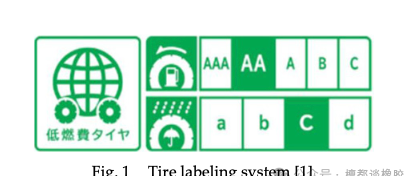
Tire labels inform consumers of performance levels and drive manufacturers to develop fuel-efficient tires. Japan introduced voluntary labeling for summer passenger tires in 2010. Tires rated A or above for rolling resistance and D or above for wet grip are classified as “fuel-efficient tires.”
3. Rolling Resistance: How It Arises
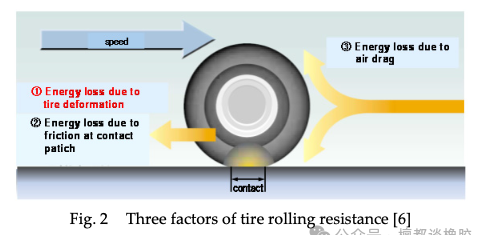
Rolling resistance comes from three sources:
- Energy loss from tire deformation — accounts for over 90% of total rolling resistance.
- Friction loss at the contact patch.
- Air drag.
As the tire rolls, the contact patch is flattened from its circular shape. The rubber undergoes large, repeated deformation, dissipating energy as heat. This repeated flexing heats the tire and consumes vehicle kinetic energy — the primary mechanism of rolling resistance.
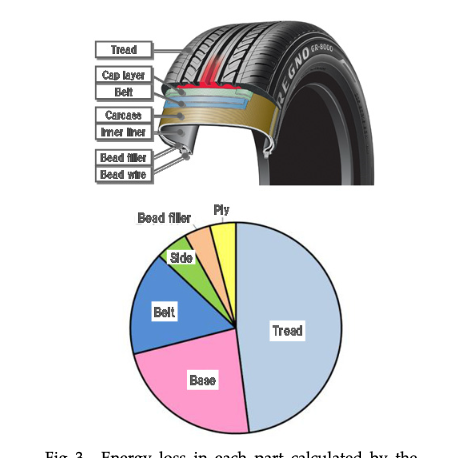
About half the tire’s weight is polymer, a quarter is filler, and the remaining quarter is rubber chemicals, reinforcement fibers, and steel cords. The tread contributes the most to rolling resistance because of its high rubber content. However, reducing tread energy loss tends to worsen grip — the core trade-off tire engineers must optimize.
The tan δ Connection
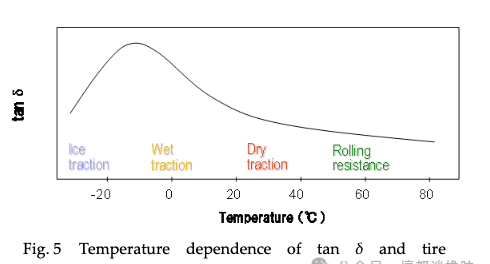
Rubber energy loss is measured by a viscoelastic analyzer using tan δ (the tangent of the phase angle δ between stress and strain). The hysteresis loop represents energy dissipated as heat. Tread compound design relies on a “property map”:
- 30–50°C tan δ up → better dry grip
- 0–10°C tan δ up → better wet grip
- ~60°C tan δ down → lower rolling resistance
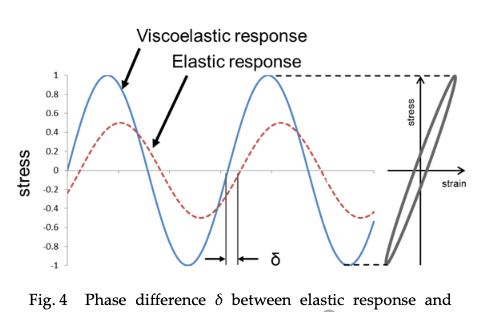
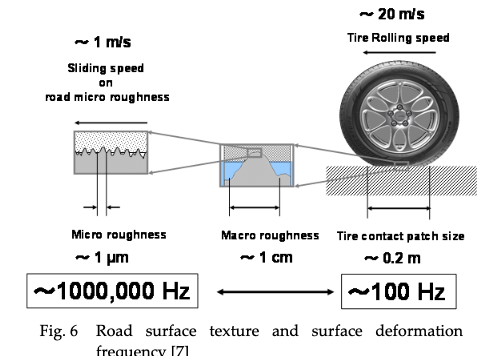
Critical insight: wet-road friction involves deformation frequencies of ~1,000,000 Hz (microscopic road roughness at 1µm scale), while rolling resistance operates at ~100 Hz (tire rotation). By the time-temperature superposition principle, high frequency = low temperature, and low frequency = high temperature. Therefore: wet grip is governed by low-temperature tan δ, while rolling resistance is governed by high-temperature tan δ — making it possible to optimize both independently.
4. Two Approaches to Reduce Rolling Resistance
Approach 1: Structural Design
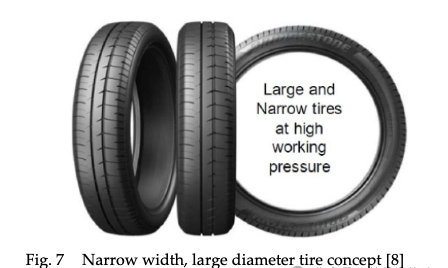
Increase tire diameter and inflation pressure to suppress deformation overall. A larger circular footprint reduces rubber flexing at the contact patch; narrower section width reduces rubber volume and energy loss. The trade-off: smaller contact patch reduces handling stability, requiring compound compensation. Large-diameter narrow tires require co-development with vehicle OEMs.
Approach 2: Compound Formulation
The core challenge is improving filler dispersion in the rubber matrix. Nanoscale FEM shows that under 15% macroscopic strain, filler agglomerations create local strain concentrations above 200% — a 10x amplification that causes enormous energy loss. Good dispersion eliminates these hotspots.
The mainstream solution is chain-end functionalized polymers: functional groups introduced at polymer chain ends interact strongly with filler surfaces (silica), suppressing agglomeration and improving dispersion. Electron tomography directly visualizes the dispersion quality. Japan’s NEDO project on “ultra-low-fuel-consumption tire 3D nanoscale rubber” uses simulation-based structural design to balance rolling resistance with wear and grip.
5. Conclusion
As vehicle parc grows in emerging markets, reducing tire rolling resistance will only become more important. Beyond tires, reducing friction in other vehicle components is a parallel R&D direction. Cross-disciplinary engineering collaboration is essential to lower overall vehicle friction, cut fuel costs, and reduce CO₂ emissions.


Leave a Reply
Want to join the discussion?Feel free to contribute!