
Tire Building Machine Shutdown & Restart Procedure: TBR Workshop SOP
Every tire factory faces planned and unplanned stops — holidays, equipment breakdowns, or mold changes. How the building workshop handles green tires, semi-finished components, and solvents during a shutdown directly determines whether restart production launches cleanly or emerges with a wave of adhesion failures and scrap. This is the standard procedure used in an all-steel TBR tire workshop.
Keywords: tire building; tire factory shutdown; green tire storage; semi-finished component; tire production restart; TBR tire; tire manufacturing SOP
Purpose and Scope
This procedure governs orderly shutdown and restart of the tire building (forming) process, covering semi-finished components, green tires, and raw materials. The production shift leader is the first point of contact; the quality process-inspection foreman handles quality decisions.
Before Shutdown: Line Clearance
At the end of production before a stop, the semi-finished goods workshop must collect all leftover components on the line. On restart, every tire remaining on conveyor rolls, tire stops, or transfer belts must be sent to QC for inspection before further processing.
Shutdown ≤ 5 Days
Cement and Gasoline
- Minimize on-hand stock of all rubber cements and gasoline.
- Cover all containers, label them, and store properly.
- Move all flammable materials to the fire-proof room or return them to the designated storage area.
Building Area
- Minimize green tire inventory. Remaining green tires must be placed in green tire trays to prevent deformation.
- All belt plies, carcass plies, sidewalls, and shoulder pads loaded on building machines must be rolled back and stored in designated process-compliant areas.
Curing Area
All green tires must be stored in green tire trays.
Shutdown > 5 Days
- All shaped semi-finished components and rubber sheets must be returned for reprocessing.
- All cut reinforcement materials (cord plies, bead wire rings, etc.) must be scheduled into production and fully consumed before the shutdown begins.
Restart Procedure
Semi-Finished Components
If the assembled bead assembly shows blooming on the rubber core:
- Separate the rubber core from the bead wire ring.
- Return the rubber core for blending per standard rules.
- Coat the bead wire ring with cement and put it back into service.
Building Machine
Check the tackiness of reinforcement semi-finished components before use:
- Normal tack: use directly.
- Poor tack, no blooming: wipe with gasoline.
- Bloomed surface: wipe with gasoline first, then recoat with cement.
- Mixing rule: adjacent components on the same tire must alternate between treated and untreated material, ensuring adequate inter-component adhesion.
Documentation and Escalation
- Every component requiring disposition gets a disposition card from the semi-finished workshop. The producing workshop inventories and records all items, and passes the list to Quality and Engineering.
- Before reuse, try to confirm the original production status. The building workshop records every dispositioned component used — component code, production date, green tire number — on the back of the machine verification log.
- If defect rate on dispositioned tires exceeds 20%, stop all dispositioning immediately.
Key Takeaways
- Short stop (≤5 days): cover solvents, tray the green tires, roll back machine-loaded components.
- Long stop (>5 days): return all shaped components; burn off cut reinforcement stock before shutdown.
- Restart: inspect tack, treat bloomed surfaces (gasoline + cement), alternate treated/untreated parts on the same tire.
- Hold the line at 20% defects: any higher scrap rate on dispositioned material and the process stops until engineering reviews.
Non-Conforming Product Handling in Tire Manufacturing: Raw Materials, Compounds & Semi-Finished Goods
A formal disposition process for non-conforming materials is essential to reduce waste while preventing defective tires from reaching the market. This standard operating procedure covers how tire factories handle out-of-spec raw materials, compounds, and semi-finished components — from inspection failures to in-use defects.
Keywords: tire manufacturing; non-conforming product; quality control; compound rejection; raw material rejection; tire factory; scrap management; rework
Scope and Responsibility
This procedure applies to all incoming raw materials, auxiliary materials, mixed compounds, and semi-finished components. Non-conforming raw and auxiliary materials are reported to the Technical Department via a tracking record. Non-conforming compounds or semi-finished goods are reported via a disposition form. The Technical Department maintains this standard; individual plants write their own detailed rules.
1. Raw and Auxiliary Materials
1.1 Non-Reinforcement Compounding Materials
| Issue | Disposition |
|---|---|
| Failed incoming inspection (except NR) | Return or exchange. Visual defects may be trialed depending on production needs. Materials with no national/industry standard may be trialed. |
| Natural rubber failed inspection | Return/exchange normally. Visible impurities → per clause below. Water droplets, mold, ash/volatiles/nitrogen out of spec: blend with good batches at ≤1:1 ratio. P0/PRI out of spec: blend at ≤1:4 ratio. |
| Impurities found in use | Easy-to-remove impurities → observe and use. Metal impurities in NR → return entire lot. Non-metal impurities in NR → sample at least 3 pallets; if any pallet has >30% contaminated blocks, return entire lot. If all ≤30%, blend at ≤1:1 in truck tread (non-OE) compounds. |
| Agglomerated small chemicals | Resins, accelerators, sulfur, antioxidants, rosin, bitumen: crush if possible, remove hard lumps, use normally. ZnO/MgO lumps → return. Liquid materials (oils, silane, release agents) with separation/sediment → return. |
| Supplier repeat failures | Two consecutive failures or >3 per year: warning if minor impact; suspension with corrective action report if severe impact. |
1.2 Reinforcement Materials (Cord, Wire, Fabric)
| Issue | Disposition |
|---|---|
| Critical property failure (cord breaking force, steel cord breaking strength) | Return entire lot. Non-critical properties may be trialed after review meeting. |
| Packaging damaged in transit, inner packaging intact | May be trialed based on production needs. |
| Short bobbin length causing excess scrap | Supplier bears the scrap cost. |
| Wrong cord规格 mixed in calender batch | Must be sorted out; supplier bears loss. Remaining uncalendered cord returned/exchanged. |
| Excessive residual twist causing cutting curl/splice difficulty | Manual splicing allowed; supplier bears cost. |
| Calender skipped/loose cords due to cord twist issues | Must be sorted; supplier bears cost. |
| Bead wire: broken strands, loose bundles, knots | Return/exchange. Hard bends or broken welds: cut out and continue; notify supplier. |
| Cord fabric: broken warp, splits, paste spots | Return. Paste spots ≤1.5 cm² each, <40 per roll; continuous warp sticking ≤5 m, max 5 per roll. Exceeding limits → return. |
1.3 Process Auxiliary Materials
- Curing/bladder capsules: Return on incoming failure. Off-center, aged, cut, internal cracks, or blisters → replace immediately and file supplier claims. Engineering tire capsules <80 cycles → claim one capsule; other capsules <200 cycles → claim proportionally.
- Tire barcodes: Return/exchange on failure; peeling labels → exchange. Three failures in one year → 3+ month suspension.
- Tire labels: Return if unusable. Minor deviation (≤10%) → concession use at reduced price. Peeling/unclear → exchange.
- Release agents, inner spray, finish liquid: Return on failure. Poor lubrication causing wrinkles/traps → return with defective tire samples for claim. Clogged spray guns → return.
- Winding fabric (liner): Thickness/appearance issues may be trialed. Delamination, peeling difficulty, or breakage → return; notify supplier for corrective action.
2. Rubber Compounds
2.1 Mastication Compounds
| Issue | Disposition |
|---|---|
| Incorrect peptizer, mixing cycle, or equipment issue | Downgrade; blend with normal mastication at ≤1:1 in subsequent mixing. |
| Sand, wood chips, iron debris found | Remove debris; downgrade; blend at ≤1:1 (never for inner liner compounds). Filter the mixed compound and thin-pass if needed. |
| Undispersed raw NR lumps | Downgrade, scrap, or return depending on severity. |
| Different grades mixed together | Downgrade to the lower grade. |
| Expired mastication compound | Blend with normal at ≤1:1. |
2.2 Masterbatch Compounds
| Issue | Disposition |
|---|---|
| Missing/under-dosed ingredient (non-polymer) | Rework per process; blend with normal at ≤1:2 in subsequent batches. |
| Over-dosed ingredient | Blend at ≤1:2 or scrap depending on severity. |
| Process/equipment anomaly | If extruded sheet looks normal: blend at ≤1:2. If abnormal: isolate, blend, or scrap. |
| Expired masterbatch | Normal appearance: blend at ≤1:2. Abnormal: isolate and decide. |
| Two masterbatches mixed | Isolate; blend at ≤1:3 or scrap. |
2.3 Final Mix Compounds
| Issue | Disposition |
|---|---|
| Wrong masterbatch type used | Isolate; blend or scrap. |
| Wrong curative type | If quick test passes: blend at ≤1:2. If fails: follow compound management rules. |
| Wrong curative amount | Isolate; blend at ≤1:3 or treat as return compound. |
| Two compounds mixed | Isolate; blend at ≤1:3 or scrap. |
| Cured lumps on sheet surface | Tread: pick out lumps, blend at ≤1:4. Other compounds: thin-pass, then load ≤10 kg per batch in same-type final mix. If unusable → scrap. |
| Wood chips, cord pieces in sheet | Thin-pass; load ≤10 kg per batch in same-type final mix. |
| Tacky/stack-stuck sheets | Clean surface, separate stuck sheets, ensure dry before use. |
2.4 Return Compounds and Semi-Finished Goods
- Cured lumps or debris in return compound: Isolate, thin-pass, load ≤10 kg per batch in same-type compound. If unusable → scrap.
- Dimensional/weight rejects: Follow return compound blending work instruction and specific formulation.
- Head compound (extruder startup): Follow return compound blending standard. If cured lumps/debris present: thin-pass then load ≤10 kg.
- Expired return compound: Blend at ≤1:1 ratio.
Key Principles Summary
- Isolate and label first: Every non-conforming item must be clearly identified and quarantined before any disposition.
- Blending ratios are capped: Downgraded compounds are blended at controlled ratios (typically 1:1 to 1:4) with normal material — never used alone.
- Supplier accountability: Quality failures from incoming materials result in return, exchange, or supplier-paid scrap. Repeat failures trigger suspension.
- Safety-critical materials are never compromised: Steel cord breaking strength, metal contamination in NR, and bladder defects that could cause tire failure are always rejected, not blended.
- Documentation: Every disposition is recorded — tracking forms for raw materials, disposition forms for compounds — enabling traceability and supplier claims.
Green Tire Pallet Conveyor System: Automated Transport for PCR/LTR Tire Plants
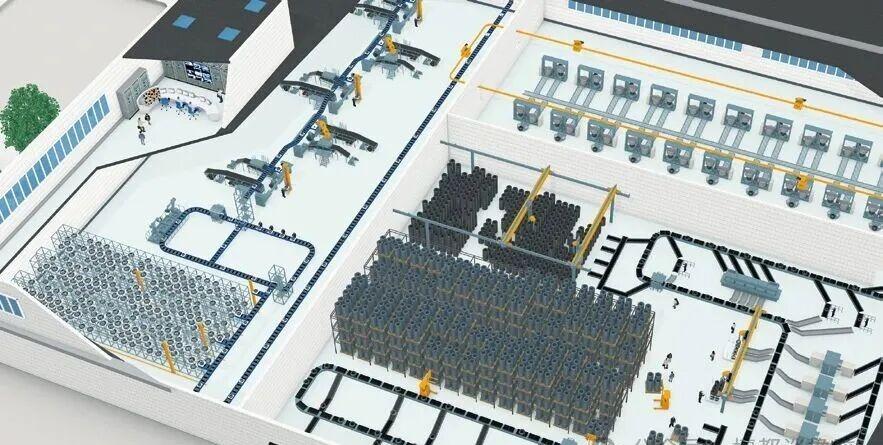
A green tire pallet conveyor system is a fully automated production-line solution for transporting uncured (green) tires between the tire building machine and the curing press in PCR passenger and LTR light truck tire plants. Each green tire stays on its own dedicated pallet throughout the process, enabling damage-free gentle transport and 100% individual track-and-trace.
Keywords: green tire; pallet conveyor; tire plant automation; tire building; curing press; WMS; MES; RFID; green tire storage
System Overview
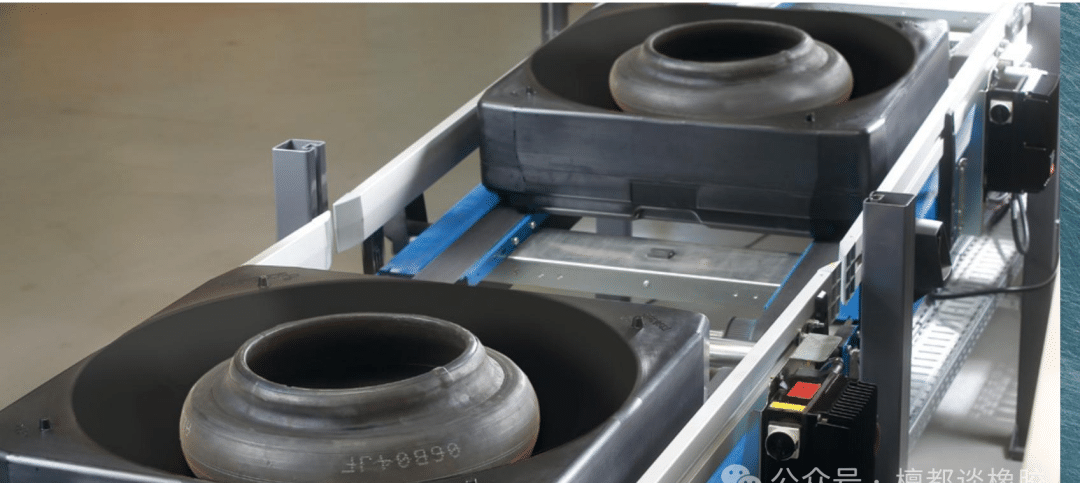
The system integrates conveying, sorting, and buffer storage into one automated line. After building, the green tire is loaded directly onto a dedicated transport/storage pallet — either manually or by a robot from the building machine. The tire remains fixed on its pallet through conveying, buffering, and curing loading. This eliminates unnecessary gripping and flipping, enabling damage-free gentle transport and precise per-unit traceability.
Key Features
- Fully integrated automation for all green tire sizes
- Complete transport from tire building machine to curing press with minimal tire handling/gripping
- RFID technology tracks every tire individually through the entire production flow
- Quick installation for new plants or retrofitting existing lines; compact footprint
Core Principle: Minimize Gripping and Flipping
The central logic: each green tire is loaded onto its dedicated pallet at the building machine, transported to buffer storage, and held there until the curing press requests it. The tire never leaves the pallet between building and curing. This contactless gentle transport eliminates extra gripping and flipping operations that could distort the green tire, dramatically improving line efficiency.
The system uses standardized modular components that can be combined on demand for high flexibility. The equipment has a small footprint, high vertical integration, very low energy consumption, low spare-parts requirements, and low maintenance costs — achieving the lowest operational expense (OPEX) in the industry.
Control and Monitoring
A Warehouse Management System (WMS) tracks every pallet throughout the process and schedules logistics, with bidirectional data exchange to MES and ERP systems. This enables full-process monitoring, scheduling, and optimization of the entire line.
Pallet and Tire Adaptation
The system uses dedicated conical pallets compatible with multiple tire sizes. The conical pallet contacts the tire bead over a very small area, preventing bead deformation and improving manufacturing flexibility and finished quality. The pallet contact surface can be lined with various materials to reduce rubber sticking.
Integration with Tire Building Machines
The pallet system connects directly to the building process. Green tires stay on pallets without repeated gripping, preventing deformation. Tires are loaded directly from the building machine onto pallets without extra lifting or repositioning. Older low-output single-stage building machines can use manual pallet loading; newer high-output machines can integrate automatic loading modules.
Optional Isolant Spraying Integration
An automatic isolant (release agent) spraying system can be integrated before or after pallet buffer entry as an optional feature.
Integrated Green Tire Buffer Storage
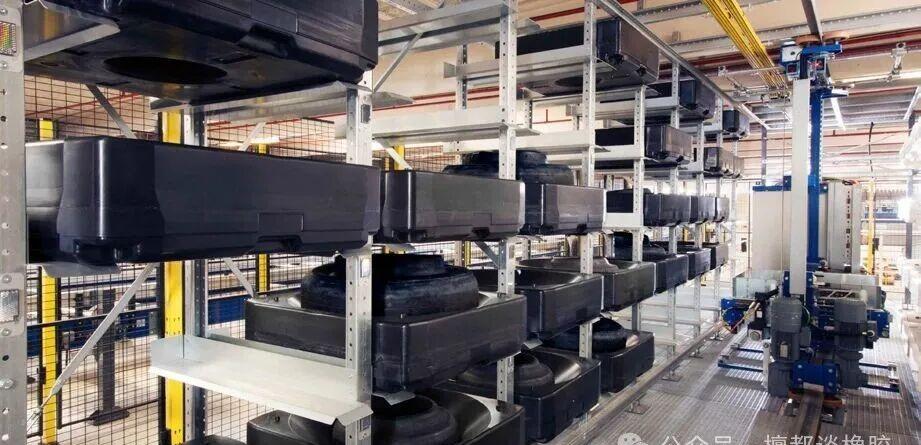
Independent pallet storage of green tires is the core function. The pallet buffer warehouse provides short- and long-term capacity buffering between building and curing. Sprayed green tires can rest and dry in the storage area. The warehouse uses Miniload (lightweight box stacker) technology: any green tire can be retrieved at any time, following FIFO (first-in-first-out) — the earliest tire of a given size is served first. In case of production anomalies, a specific tire can be quickly and precisely retrieved.
The storage unit consists of rail-mounted stacker cranes, lightweight pickers, conveyors, and steel racks. A single warehouse has 500–1,500 pallet locations depending on line capacity; multiple warehouse units can be combined to achieve optimal buffer capacity in limited space.
Automated Curing Press Loading
Curing is the core high-cost process in tire manufacturing. Wrong green tire loading wastes energy and raw materials and can damage the curing press. The automated pallet conveyor delivers the green tire (on its pallet) directly to the curing press, fully eliminating extra gripping and flipping. The system also includes a tread splice positioning correction unit that aligns the tire joint before loading, avoiding mold defects.
Manual Workstation
A dedicated manual workstation allows operators to load/unload pallets and perform manual inspection. Tires that cannot be identified by the automatic system (barcode read failure) are diverted to the manual station, where operators use handheld scanners to enter tire data.
Standard Modular Components
Line Interface Modules
- Tire building machine interface
- Automatic isolant spraying system
- Curing press loading conveyor
Conveying Modules
- Straight conveyor sections
- Curved sections
- Acceleration/deceleration sections
- Vertical lifts / circulation elevators
Sorting Modules
-
li>Diverters
- Mergers
- 90° transfer cars
- Vertical sorting units
Storage Modules
- Pallet Miniload warehouse
- Through-flow pallet buffer line
Full-Process Traceability
The system achieves 100% precise tracking of all pallets. The location and data of any individual green tire can be queried at any production step. Operators can check the real-time position of any pallet; the system has preset tracking points that automatically report data as pallets pass. Pallets can be stopped or started at any time without losing trace information.
Technical Parameters
| Parameter | Value |
|---|---|
| Conveyor speed | 2.3 m/s (6.6 ft/s) |
| Line throughput | 2,500 pallets/hour |
| Tire inner diameter (bead) | 330–660 mm (13–24 inches) |
| Tire outer diameter | 450–875 mm (18–35 inches) |
| Max green tire weight | 35 kg (77 lb) |
| Pallet size | 900 × 900 mm |
Rubber Mixing in an Internal Mixer: Step-by-Step Operation Guide
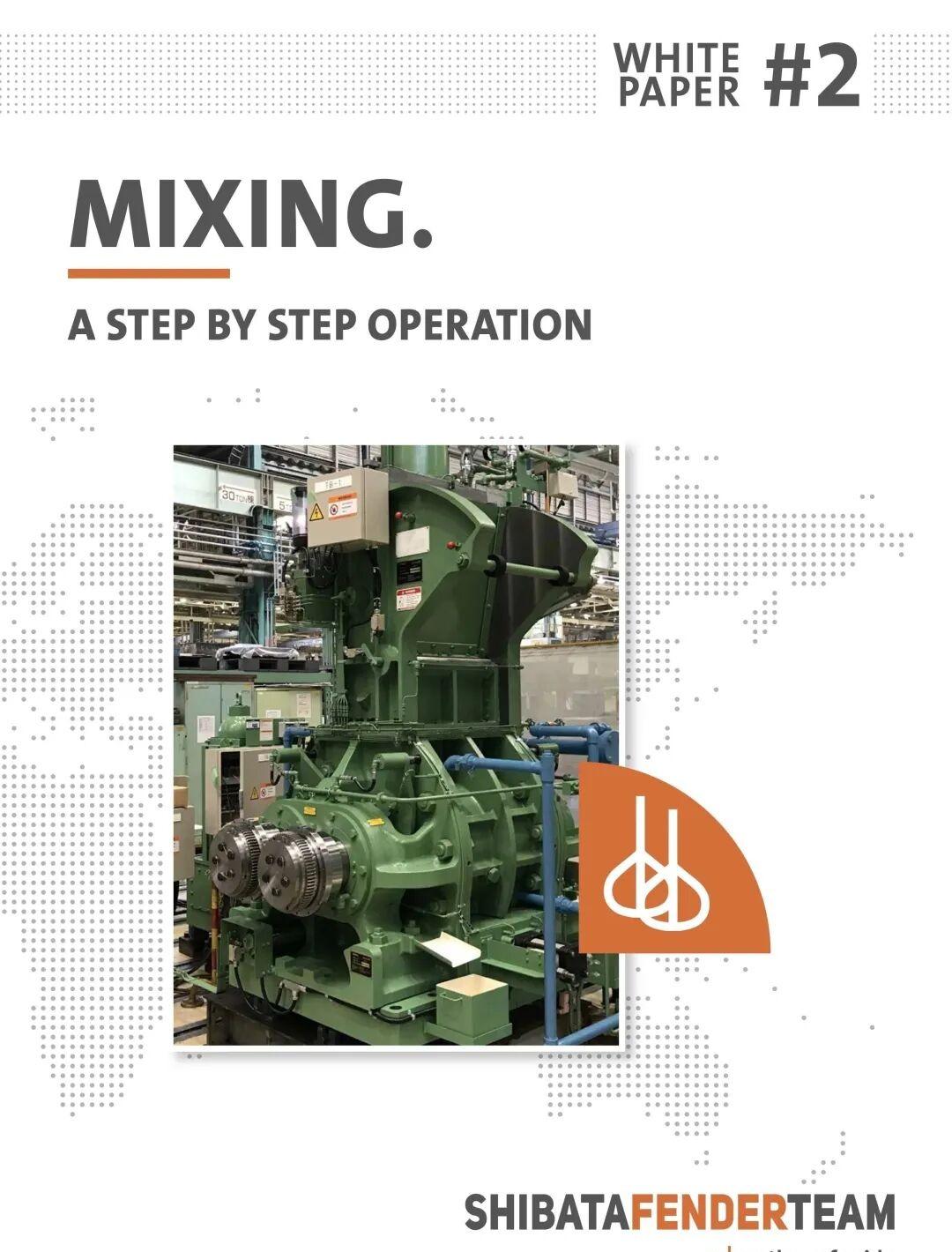
This article is based on the Shibata Fender Team (SFT) White Paper Series Part II — Mixing. It walks through the complete two-stage rubber compounding process: mastication, masterbatch production, and finalization, with the equipment and operational principles behind each step.
Keywords: rubber mixing; internal mixer; banbury; mastication; masterbatch; finalization; two-stage mixing; rubber compounding; fender manufacturing
Executive Summary
Fender manufacturing, like all rubber product manufacturing, relies heavily on practical knowledge and experience. The complex interaction between raw material composition, mixing equipment, and process parameters makes uniform high-quality output difficult to achieve without deep expertise.
Current international standards (PIANC 2002, ASTM D2000, EAU 2004, R20 2.0-11 (2012), or BS6349 (2014)) only define the final physical properties of a fender — they do not specify the chemicals used or the mixing equipment. The manufacturer’s performance and process know-how remain the defining factors.
This white paper outlines the individual steps of rubber mixing to show how a high-quality fender (or tire, or any rubber product) is built up through controlled processing.
The SFT White Paper Series
The four-part series covers the entire process from rubber compounding to final product testing:
- #1 Compounding — raw materials and their correlation to final properties
- #2 Mixing — the mixing process and equipment (this article)
- #3 Curing — manufacturing and vulcanization
- #4 Testing — final product testing and quality verification
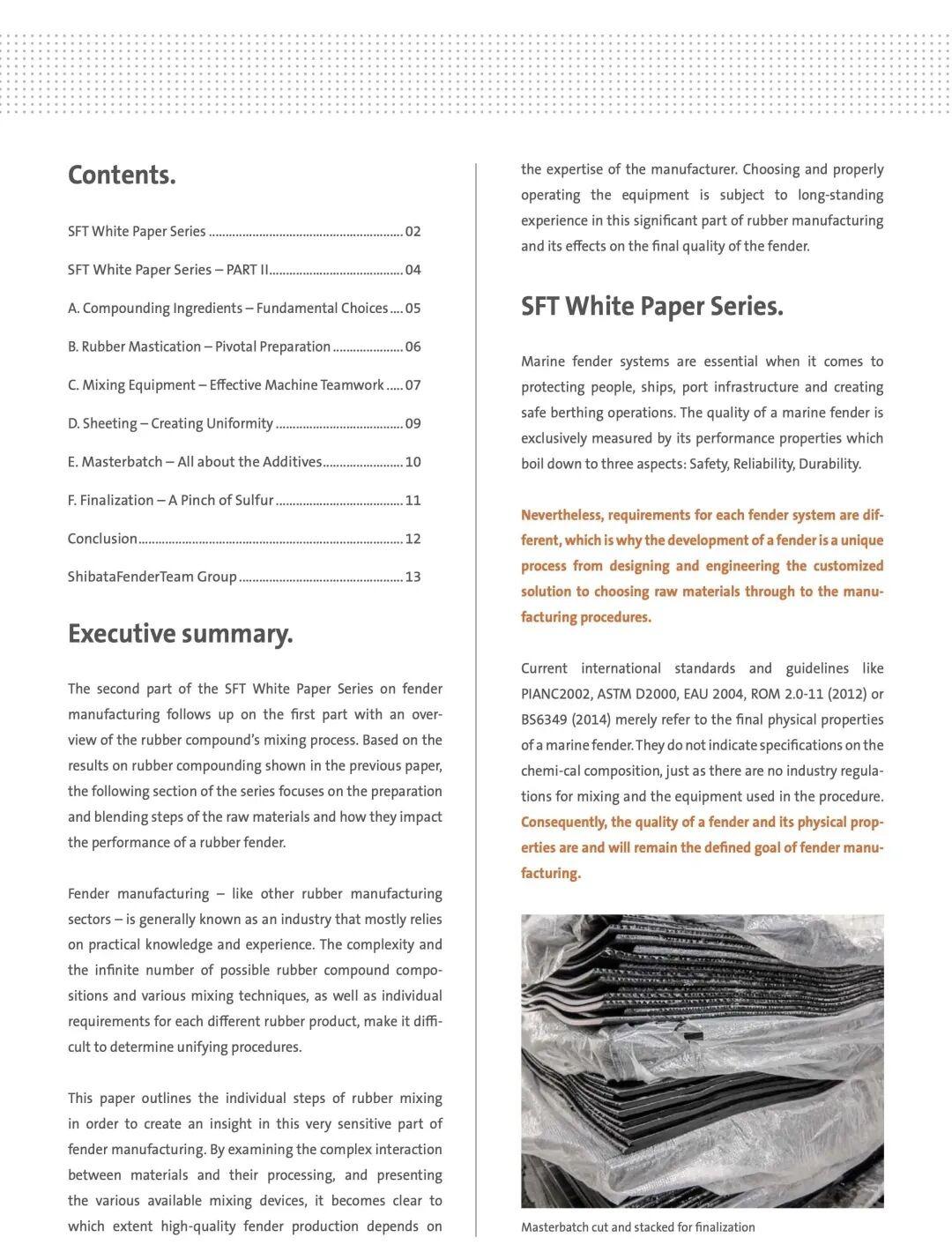
With its White Paper Series, SFT advocates transparency in fender production to ensure quality standards driven by a commitment to high-performance products.
The Two-Stage Mixing Process
Since mixing is essential to rubber product quality, this part focuses on the individual phases: mastication → masterbatch production → finalization.
Rubber processability, reliability, and economic efficiency require high-performance industrial mixing equipment. To achieve homogeneous distribution of compounding ingredients and high dispersion, the manufacturer depends on well-matched equipment choices for each production step.
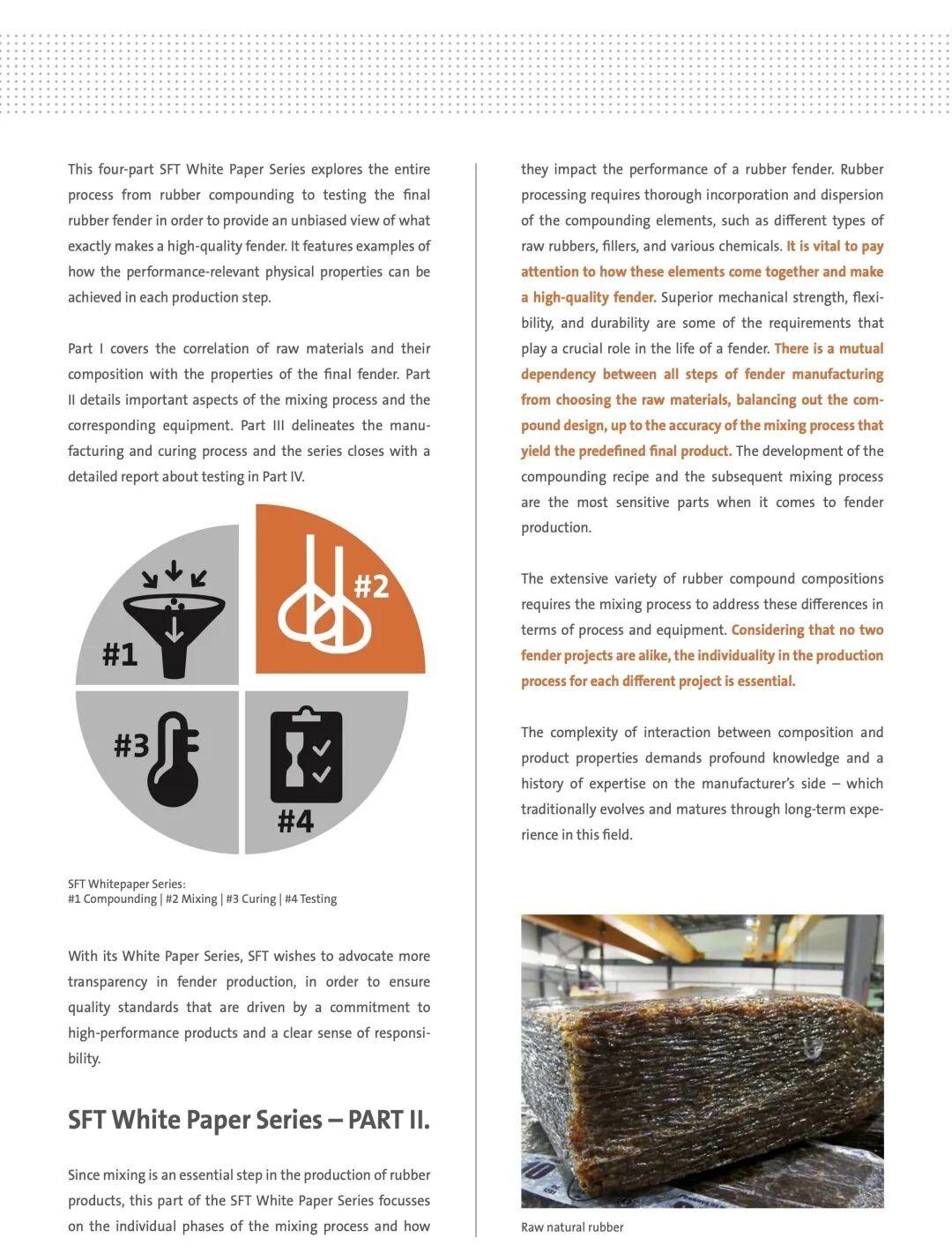
Note: The following procedure illustrates a two-stage mixing process. Single-stage mixing in an internal mixer is also possible, but not ideal for all compounds. Two-stage mixing separates the high-energy dispersion work (masterbatch) from the low-temperature vulcanization-incorporation work (finalization), preventing premature cure.
A. Compounding Ingredients — Fundamental Choices
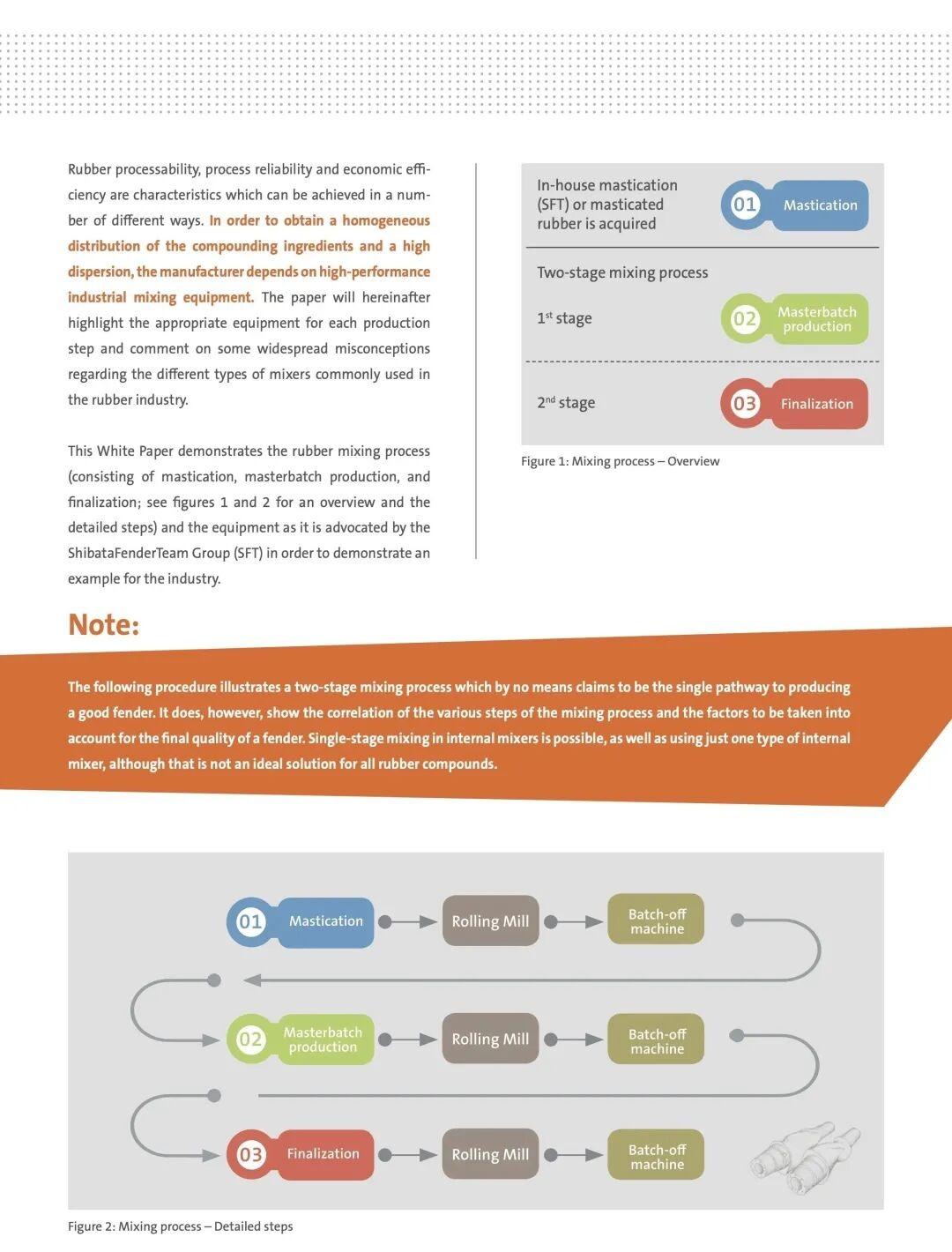
A well-considered chemical composition is the cornerstone of a high-quality rubber product. The selection of raw rubber is particularly important because natural rubber (NR) as a natural product varies in viscosity due to molecular weight and uneven molecular distribution.
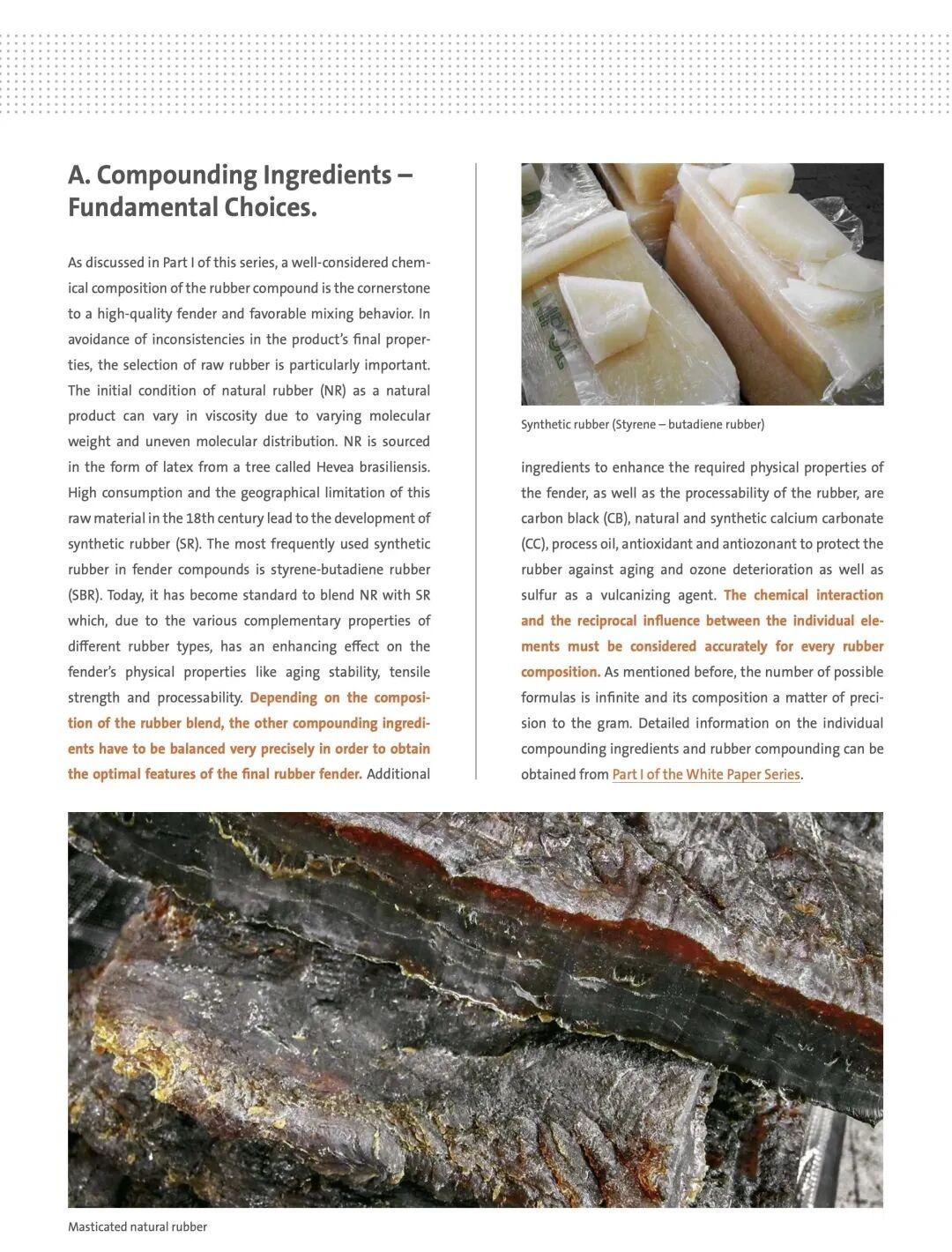
Natural Rubber (NR) is sourced from Hevea brasiliensis. High consumption and geographical limitations led to the development of synthetic rubber (SR). The most common synthetic rubber in fender compounds is styrene-butadiene rubber (SBR). Today it is standard to blend NR with SR — the complementary properties of different rubber types enhance aging stability, tensile strength, and processability.
Other ingredients — carbon black (CB), natural and synthetic calcium carbonate (CC), process oil, antioxidant, antiozonant, and sulfur as vulcanizing agent — must be balanced precisely depending on the rubber blend composition. The chemical interaction between individual elements must be accurately controlled. Formulation precision is measured to the gram.
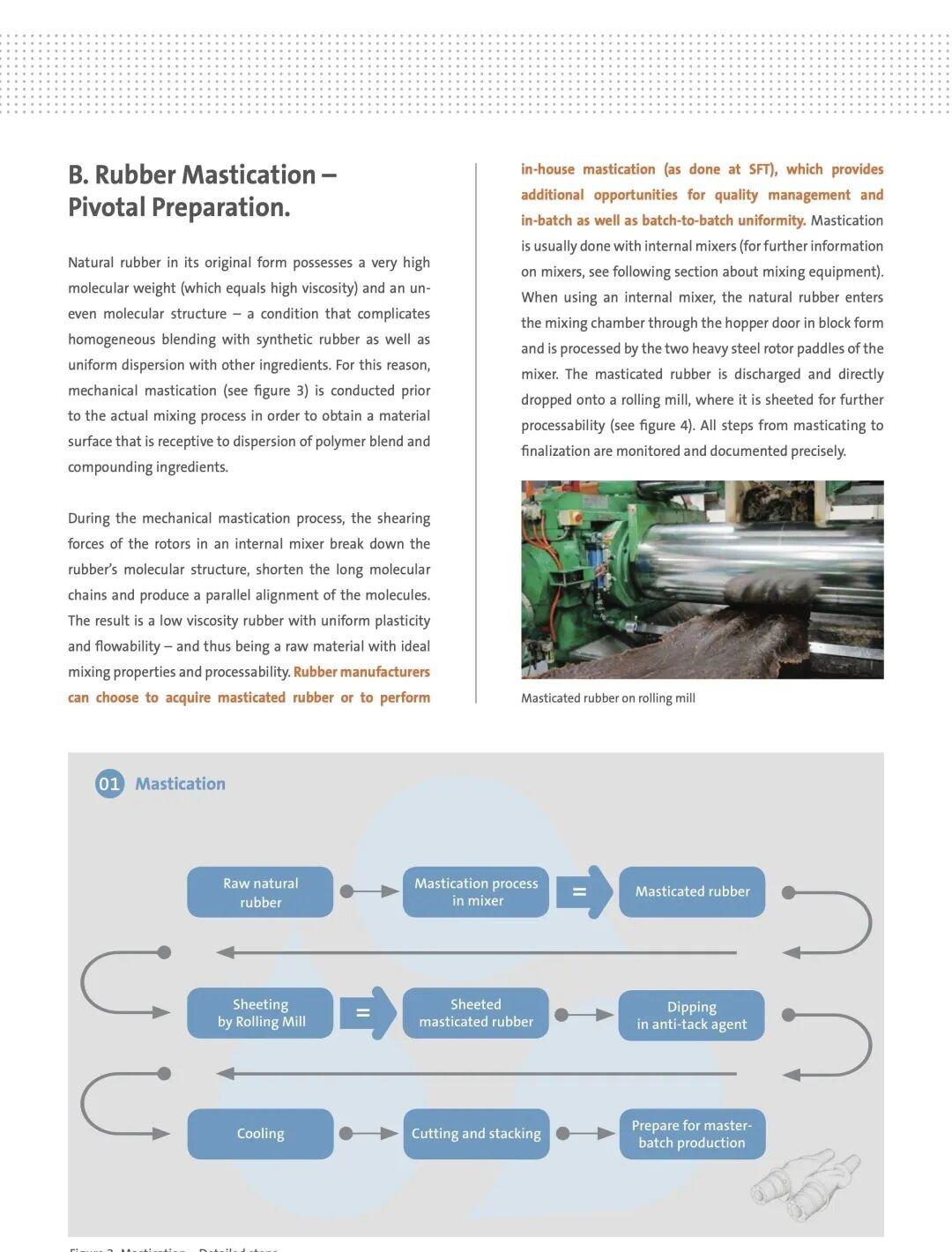
B. Rubber Mastication — Pivotal Preparation
Mastication is the mechanical breakdown of high-molecular-weight natural rubber into a more processable, flowable state. This is done either in-house or purchased pre-masticated. The goal is to reduce Mooney viscosity so that subsequent mixing steps can incorporate fillers and chemicals uniformly.
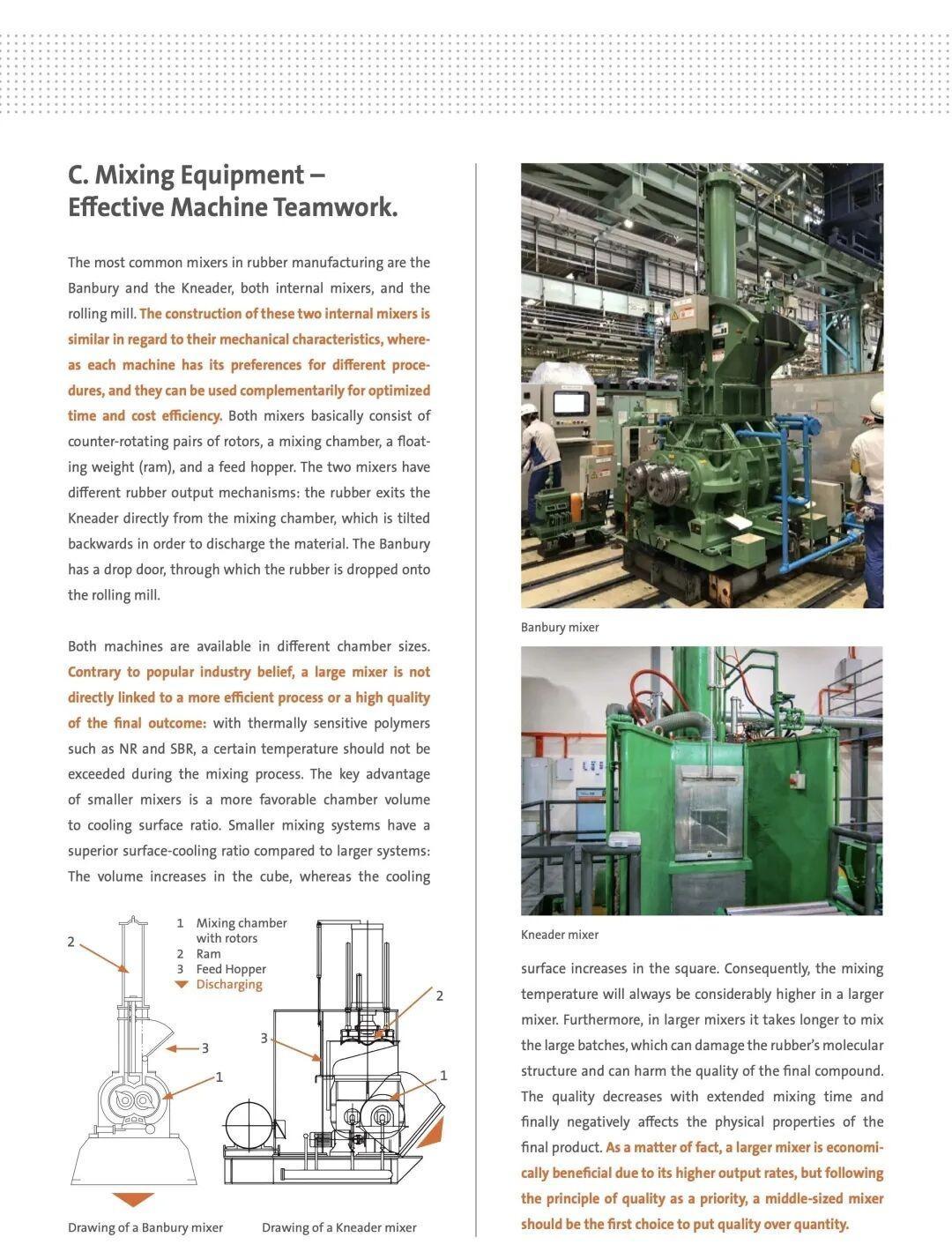
C. Mixing Equipment — Effective Machine Teamwork
The internal mixer (Banbury-type) is the workhorse. High-shear rotors generate the dispersion needed to break up filler agglomerates and distribute them throughout the rubber matrix. Cooling of the chamber, ram pressure, rotor speed, and dump temperature are all recipe-controlled.
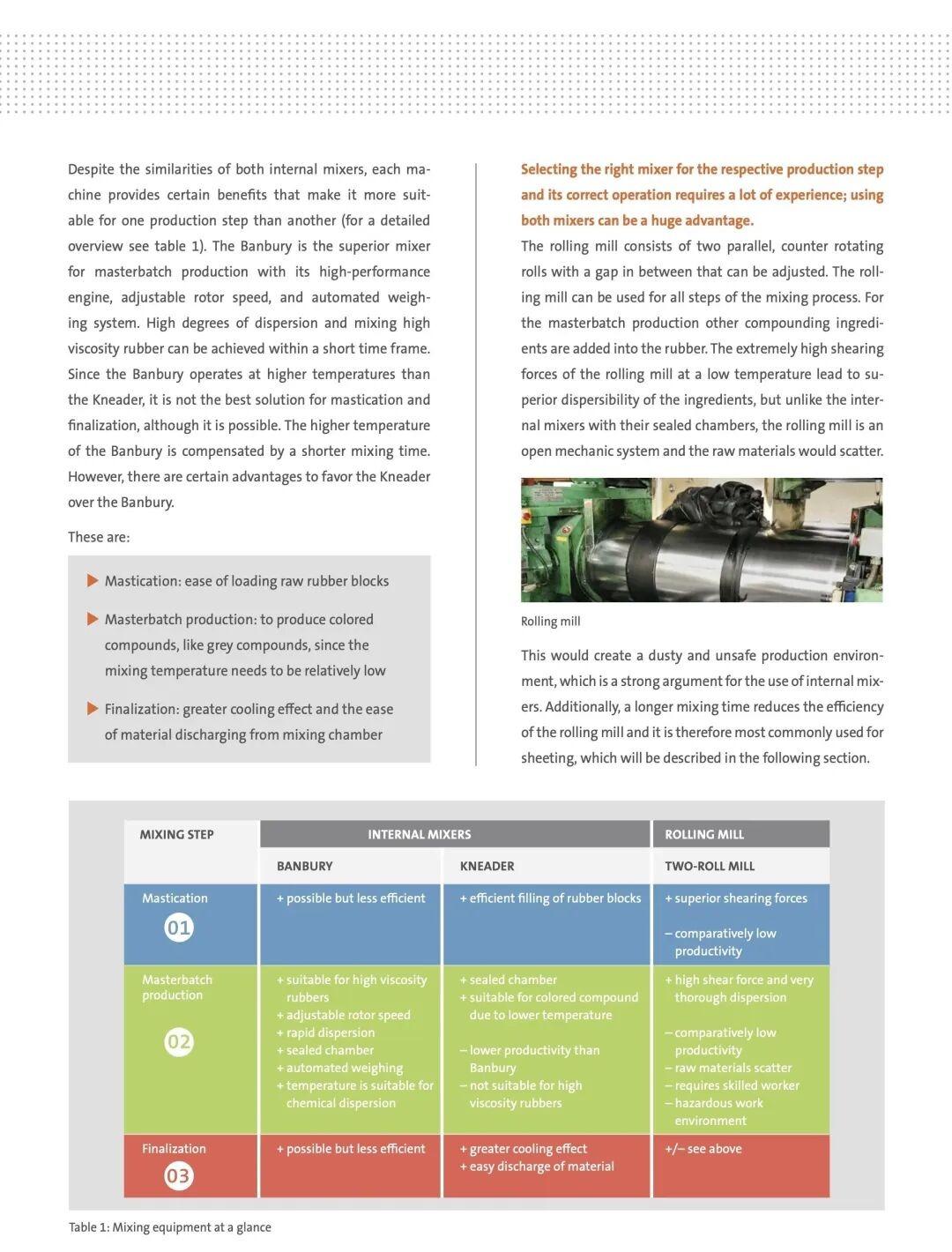
D. Sheeting — Creating Uniformity
After each mixing stage, the batch is dropped onto a rolling mill (open mill), sheeted out, and cooled on a batch-off conveyor. This equalizes temperature, forms a handleable slab, and allows inspection. The two-stage process means the masterbatch is sheeted, cooled, and then re-loaded for the finalization stage where sulfur and accelerators are added at lower temperature.
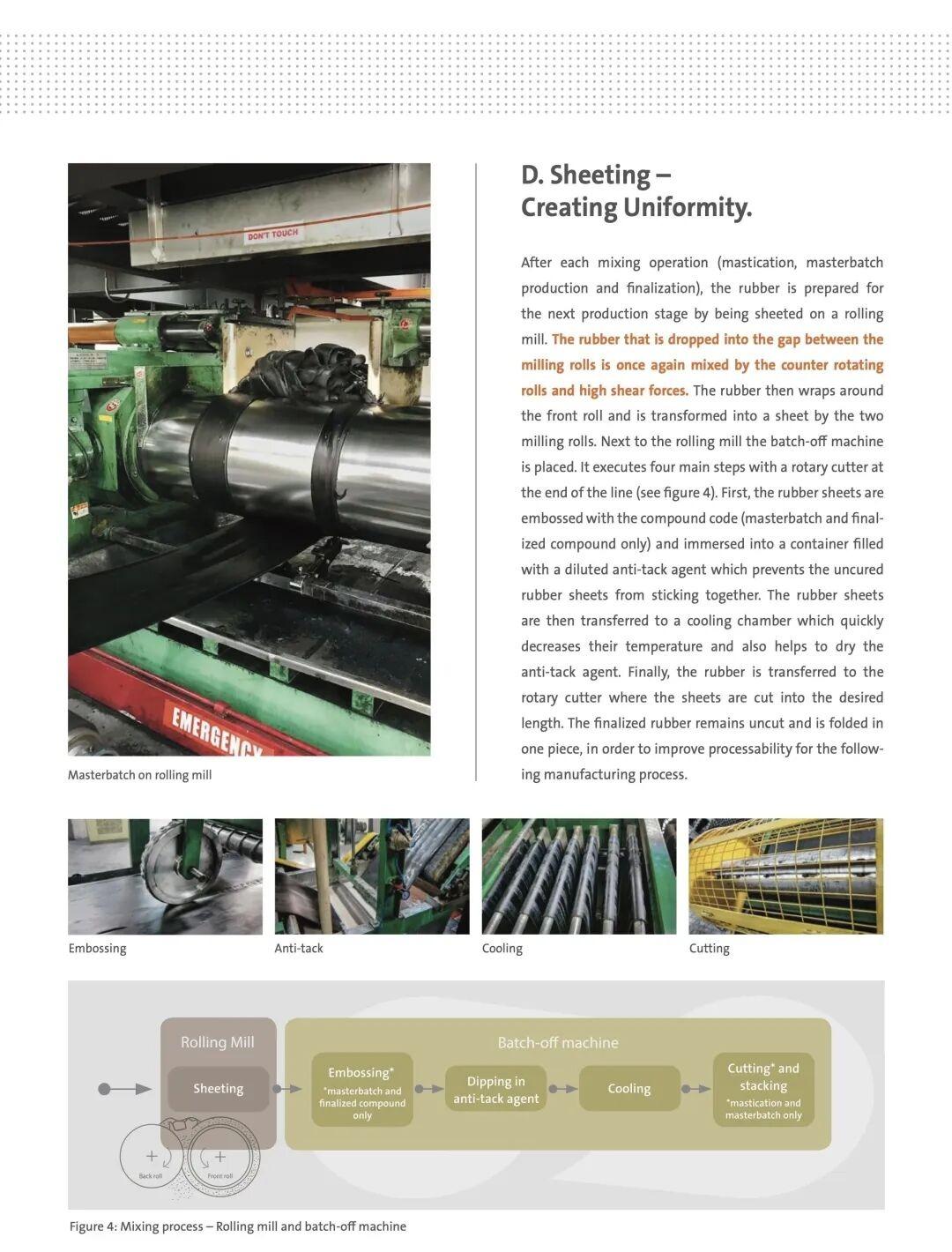
E. Masterbatch — All About the Additives (1st Stage)
The first (high-temperature) mixing stage incorporates all ingredients except curatives: base polymers, carbon black/filler, oil, antioxidants, activators (zinc oxide, stearic acid). High temperature (typically 140–160°C) drives the filler-rubber interaction and dispersion. The masterbatch is then dropped, sheeted, and cooled.
0
F. Finalization — A Pinch of Sulfur (2nd Stage)
The second (low-temperature) stage re-mills the cooled masterbatch and adds sulfur and accelerators at temperatures below ~110°C to prevent scorch. After finalization, the compound is sheeted, cooled, and ready for curing.
1
2
3
4
Key Takeaways
- Two-stage mixing is the industry standard for quality compounds: masterbatch handles dispersion at high temperature; finalization adds curatives at low temperature.
- Mastication reduces NR viscosity for consistent processing.
- Formulation precision matters to the gram — filler-rubber interactions define the final properties.
- Equipment and process experience — not just raw material choice — determines final product quality. Standards define the output, not the process.
- Every step (mastication → masterbatch → sheeting → finalization → sheeting) feeds into the next; skipping or shortening any step degrades dispersion and consistency.